
Your branding
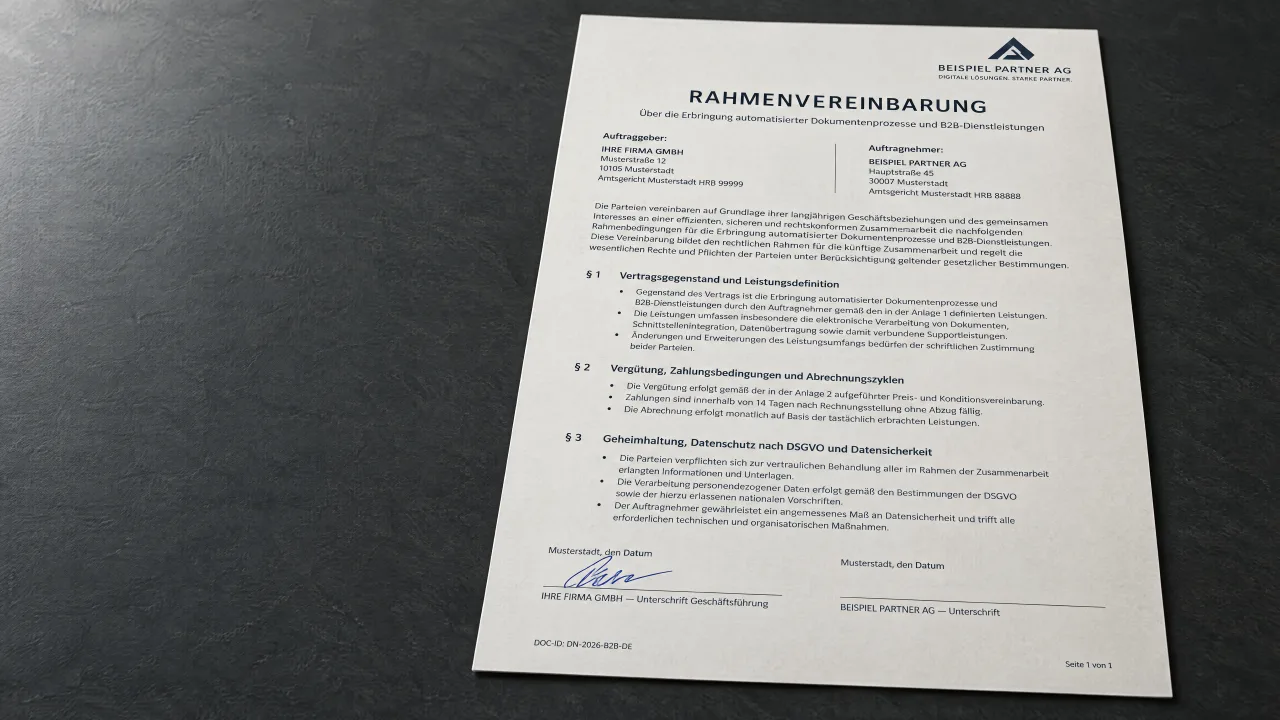
Logo, typefaces, header and footer. In the end, your client holds a document that clearly belongs to your company.
If you negotiate every contract individually, the only way to handle more contracts is to hire more people. A fixed contract text removes that limit. You set it up once and from then on only fill in what changes.
The problem
Every deviation costs a review, a query, an approval. With ten contracts a year, nobody notices. With two hundred, it is someone’s job. The formatting chaos everyone complains about is only the visible part: shifted headers, three different typefaces, a client name left over from the previous contract. Underneath lies the real flaw: there is no fixed text that everyone starts from.
How it works
The first takes an hour per contract type. The other two take minutes and repeat.
Store your contract text once and mark what changes from case to case: name, amount, date, term.
For each new contract you only fill in the marked fields. The text stays exactly as you approved it.
Typeset and ready, with your logo, your typefaces, header and footer, and a signature field for each party.
The result
A flawless, print-ready PDF at the push of a button, formally correct and ready to sign.
They also explain why some things are deliberately missing.
Logo, typefaces, header and footer. In the end, your client holds a document that clearly belongs to your company.
A lease with a landlord, two tenants and a guarantor is simply a setting. Names may be left blank.
For every contract, it is on record which version of your template it was created from. Even three years later.
People in HR get access to employment contracts, people in sales to customer contracts. You decide this per person, and more users don’t cost more.
The application runs on servers in the European Union. That is where your contracts are created, and that is where they stay.
Who it’s for
New clients, new jobs, new people: wherever the same contract is drawn up several times a year, a template pays off. The overview shows what that looks like in individual sectors, from a daycare centre’s childcare contract to a maintenance contract in the skilled trades.
FAQ
Sign up and we will notify you as soon as the free trial starts.