
During negotiation
Every deviation is discussed, agreed and reviewed. That takes roughly the same time every time, however small the deviation.
Nobody who renegotiates every time can manage hundreds of contracts a year. You decide once what goes in. After that, it only needs signing.
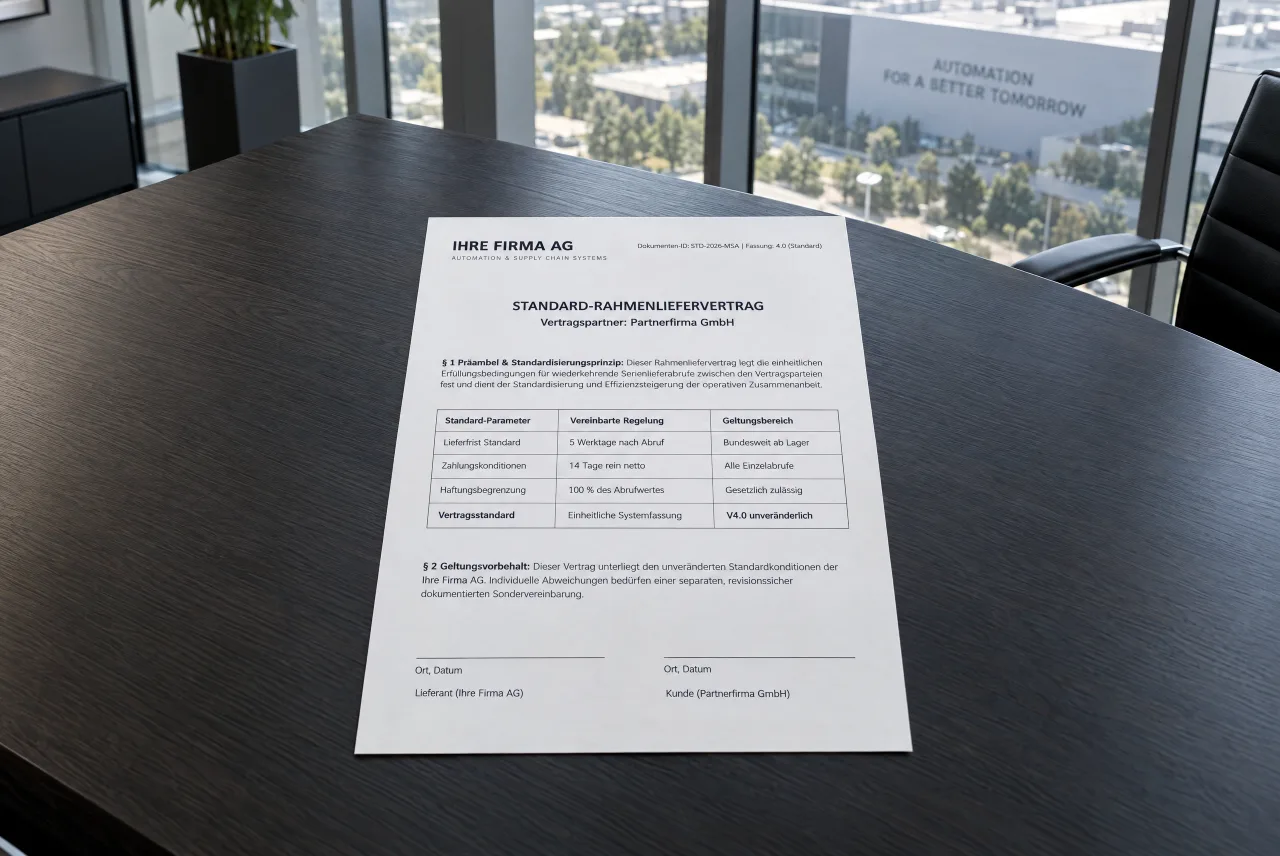
The contract itself is done quickly. The deviation is what gets expensive. You pay for it in three places, and only the first one shows.
Every deviation is discussed, agreed and reviewed. That takes roughly the same time every time, however small the deviation.
The deviation becomes a document of its own. Someone reformats it by hand and overlooks the one spot that nobody finds until years later.
At some point someone asks what was actually different in this version. The answer is in a file that has been copied three times since.
A standard doesn’t restrict you. It makes sure the two-hundredth contract is done as quickly as the second.
You set up the template once. After that you only fill in the values, and the PDF is ready.
Every published version is frozen. If you change a clause later, contracts already sent remain unaffected.
Anyone on the team can send the standard. A specially negotiated version can later only be explained by whoever was there.
Logo, typeface, sizes and spacing are set once and apply to every document.
Enforcing it
DocuNorm has no if-then rules in the contract text and no clause library. A template is a text with placeholders, nothing more. If you really need a different version, you create a second template. That is deliberate: it makes the exception visible and countable instead of letting it vanish into a file someone once copied.
Scope
If you negotiate every contract individually, you track negotiation stages, compare clauses and obtain approvals. DocuNorm starts later: with the contract you have decided on.
Sign up and we will notify you as soon as the free trial starts.